Book Proposal
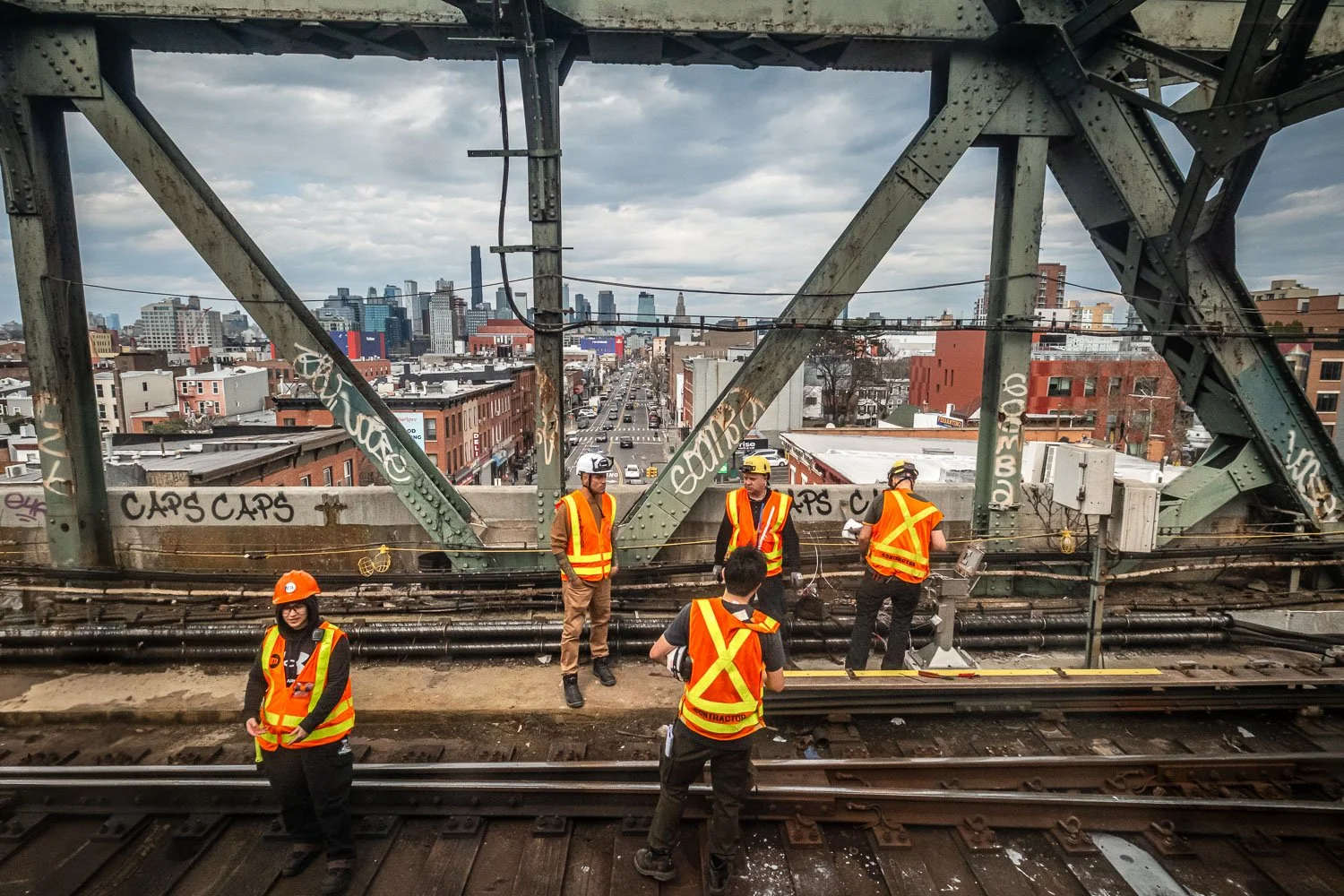
The elevated track of the New York subway, quite high in some areas, provides raised vantage points for exciting city vistas and dramatic scenes of urban living and commercial decay. I photographed the images for my proposed photo book, ELEVATED: The New York Subway Above Ground, from trains and platforms throughout the four New York City boroughs crossed by above-ground sections of the subway system.
This is the New York City that people who walk (or drive or ride the bus) rarely see.
The photos include views of borough landscapes, trains and tracks, platforms and riders, train operators and, of course, pigeons. Some photos were taken through train front windows with “operator’s eye view”, often making an intriguing mix of reflection, refraction, and double exposure due to the two panes of glass. The book is not primarily about trains—it instead captures the visual experience of riding the subway above ground, and discovering the sublime in the commonplace New York. (The several photo books of the last 20 years are largely b&w, feature subway riders almost exclusively, and were mostly photographed underground.)
The book will intrigue people surprised by unfamiliar views of the great city they thought they already knew, and also speak to enthusiastic railroad fans all over the United States.
Suzanne McIntire
A note on the photographs
The train operator’s cab generally has four windows. One is centered opposite the small forward-facing window in the door to the passenger compartment, one is to the right in front of the driver, and another on each side of the cab. I took a number of these photos from the passenger compartment directly through both these two center windows, for a view of the tracks and platforms ahead. The two panes of glass often cause a double exposure effect, and sometimes also color artifacts due to light refractions and polarized windshields.
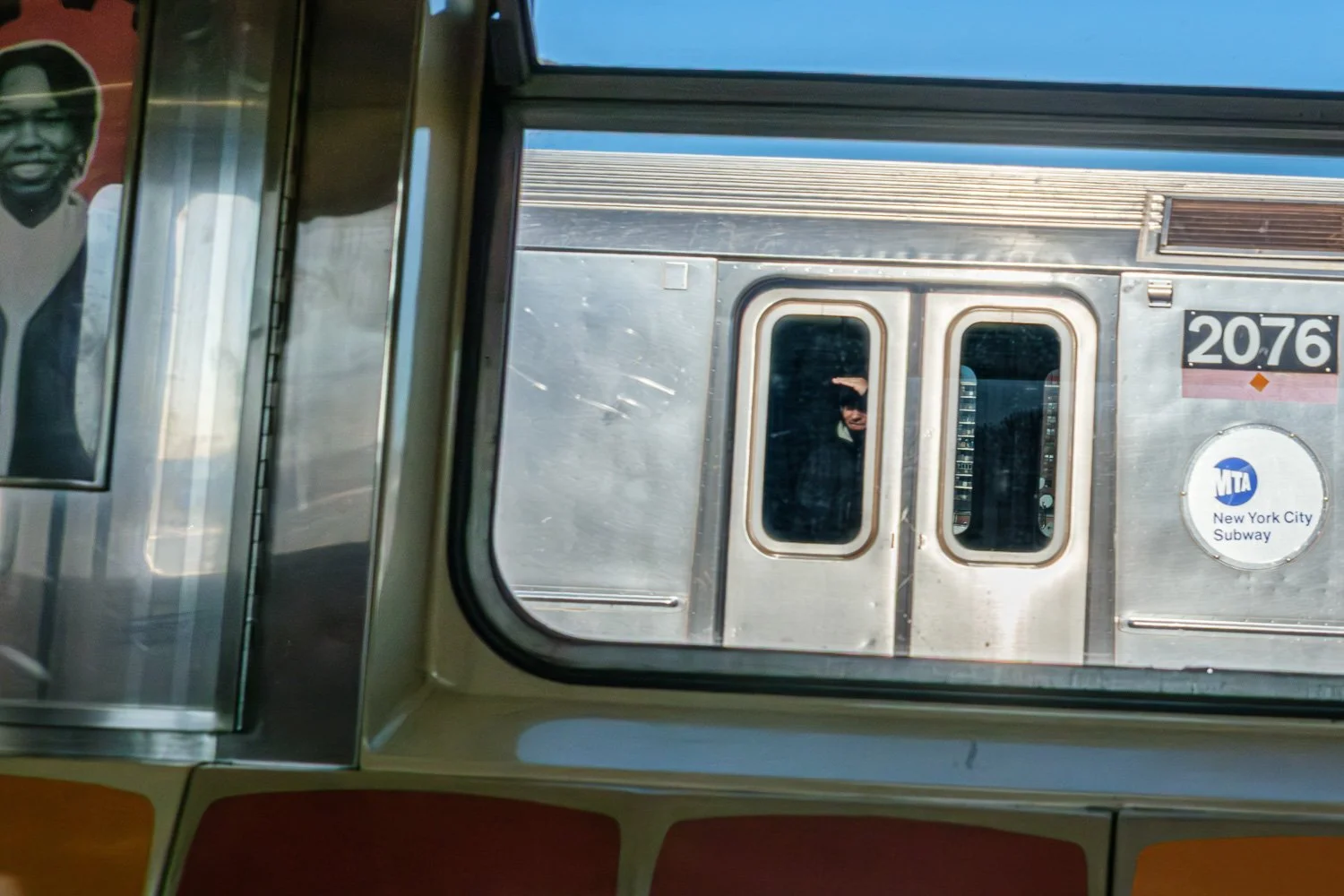
The reflections on these two panes of glass sometimes further add complexity to the image—these are mirror images occurring inside the cab as well as in the passenger area, and are reflections of outside spaces as well as the train interior. Objects to the side of the train are moving by much faster than what is ahead (because they are closer to the camera) and may be significantly blurred both in capture and in any reflections they cast. A single photo may contain all these kinds of reflection. Passengers may even wrongly appear to be inside the cab.
Dirt, raindrops, slush, and reflections are unavoidable on train windows, and I found all these interactions to be what makes these pictures subway verité. None of the photos were Photoshopped or are composites.
Preface
For a time, I was an American child living in India. My family rode the trains to the beach, and I was intimidated by the clamor and chaos of the Indian railways, but the landscape from the train was something that kept me at the window.
My British friends were sent home to boarding school as they approached twelve, and I made the mistake of telling my father I also wanted to go. Too soon, my brother and I were parked at an American missionary boarding school in the south of India. Little about the experience was good, worse for my fourth-grade brother, but we got to ride the Indian trains long distance.
A train car then was its own private world, as you couldn’t walk from car to car the length of the train. We had two large rooms—empty except for bare bunkbeds—for those of us schoolmates traveling in the same direction. We were an unchaperoned, vulnerable, danger-prone crowd, elementary to high school age. The windows had no glass, only bars. Rain drove through the windows and sloshed across the floor.
At sunrise the landscape opened up—a luminous pink and green early morning like I never saw at home in the city, in Calcutta. Palm and banana trees and swimming rice fields raced by, there were signs I couldn’t read, people doing what I couldn’t interpret, abundant dogs and goats. Kindly people shared the idli rice cakes they made while we squatted together on the platform. I had no camera to record it all, alas, alas. The next year a schoolmate died climbing on the outside of the train.
That was what I knew of trains then.
I have a camera now, and I’m on the subway in New York City.
There is the same press of people and commotion, and I hear taped admonishments not to ride outside the train. Emerging into the light aboveground is like an Indian sunrise after the dark below. There are riders sharing concern for me, not unlike the way Indian passengers had fed us—saying get off here to take a picture, but don’t get off there, and cleaning my filthy window from the platform when they see me shooting through it.
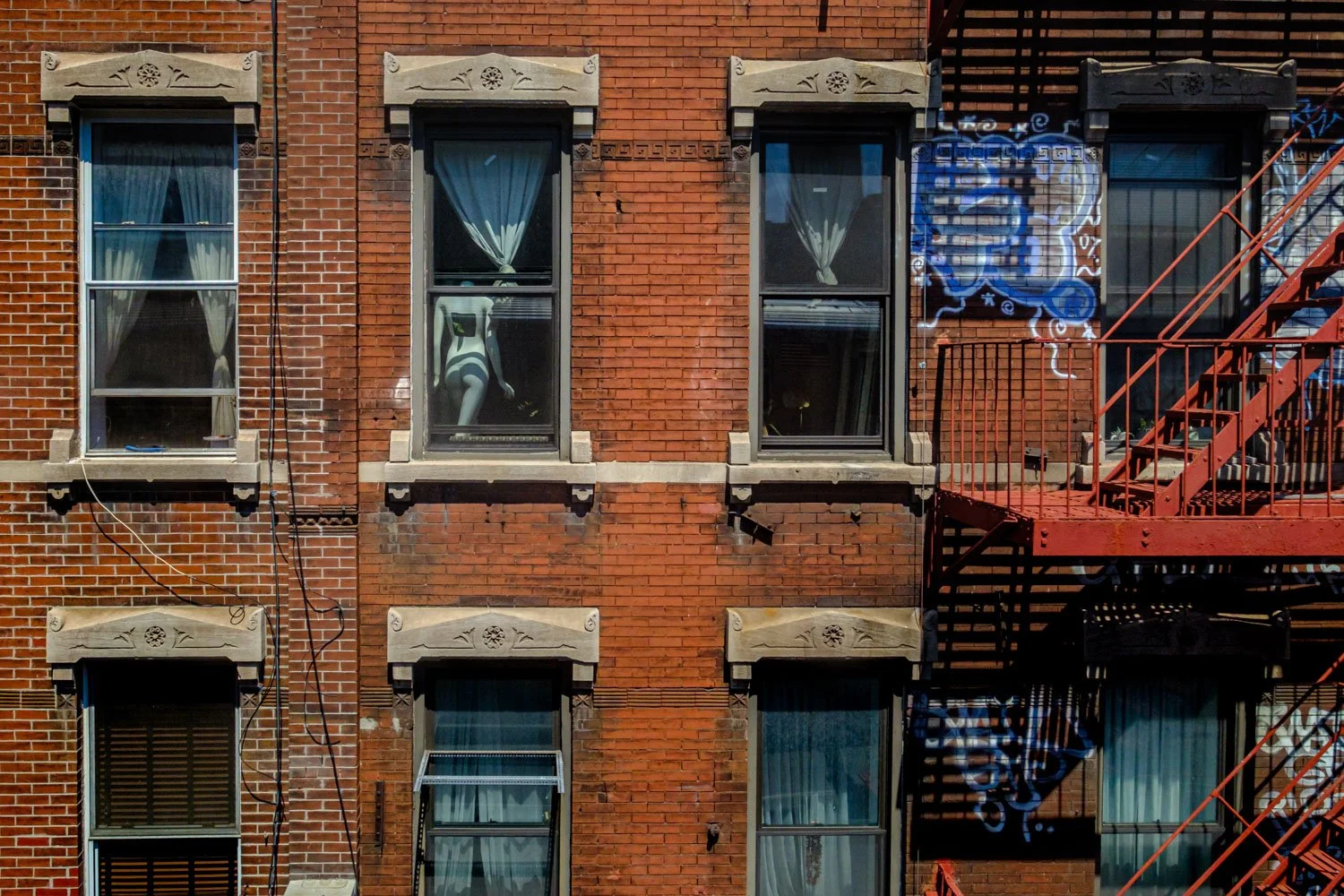
The landscape is just as compelling, just as surprising. Why why why a window filled with tennis balls? Is the naked mannikin positioned just so especially for those of us riding the train? So astonishing are the rooftop landscapes of air handlers, pizza signs, antennas, barbed wire. And the graffiti—oy vey. Riders are doing what, on the platform in head-scratching ways that again I can’t understand.
Glorious riveted steel and riveting bridges rush by. Some of these high platforms feel like I’m at the top of the city. The tracks cross and uncross, curve and straighten, and trains dive to levels below.
Here in New York the rain doesn’t come through the window, it settles on the glass and confuses the lens—where to focus? Finally it finds the dance of the pigeon and owl, the rusting patina of graffitied superstructures (so painterly), the enigmatic backsides of signs I can’t read, rooftop bee-hives, waters-edge cormorants, the all-American heaps of old tires. The winter slush finally fools the lens utterly.
Some of what there is to see is the underbelly, the back yard, the closet, the secret soul of the city. To see it is to understand the city better. We see the baring of painful thoughts—homesick, love me, distrust. There must be, have to be, riders looking on who sympathize.
And on to our destination, silvery rails converging ahead. We are glimpsing fans wearing their devotion to the stadium, the serene smiles of bookkeepers leaving for home, a rider’s jacket closed with a door key, track workers at unknowable tasks. The train we’re riding reflects its beauty in one after another glass building, and will eventually reach the rail yard that trains call home.
Some of us got off earlier, and it was a trip, but for the trains it is journey’s end. Until tomorrow when they begin again.
Suzanne McIntire
Who I Am
Suzanne McIntire (Arlington, Virginia) is a former Smithsonian Natural History museum staffer who photographed small fossils in the imaging lab for many years, and is now the volunteer assistant to the Senior Curator of Photographs at the National Portrait Gallery. She took the images for her book, An American Cutting Garden (Univ of Virginia Press), and edited The American Heritage Book of Great American Speeches for Young People (John Wiley). Her first zine, Nature Study, was published by StrudelmediaLive in 2025. A Triassic pterosaur, Eotephradactylus mcintireae, was recently named for her by researchers at the Smithsonian.
Her interest in fine art photography began on a Nebraska fossil dig, when snow made work impossible. She ventured out with a camera, and discovered a love for visual humor, the visually incongruous, for things no longer looking the way they’re supposed to, and always for verisimilitude.
Suzanne won the Washington Post Humor Photo Contest in 2012 and has been exhibited in galleries in Virginia, Washington, and Maryland: at Glen Echo Photoworks, Maryland Federation of Art, Art League of Alexandria, Montgomery College, Alexandria Atheneum (Northern Virginia Fine Arts), Exposed DC, Mid-Atlantic PhotoVisions, Falls Church Arts, Arlington Artist Alliance, and the Hill Center on Capitol Hill. Additionally at the Griffin Museum of Photography, Winchester, MA.
Suzanne McIntire
Competing Titles
There have been a few photo books of the New York City subway over the years, but most all have focused on riders. The city landscape is an afterthought, a few pictures perhaps. Several of these books were shot exclusively underground.
First Stop Last Stop by Rita Nannini (Workshop Arts, 2023), color, features only the last stops on various subway lines.
Station to Station by Ed Hotchkiss (Daylight Books, 2022) is black and white, primarily of riders below ground.
Subwaygram by Chris Maliwat (Daylight Books, 2022) are primarily photos of people within subway cars, almost entirely underground.
Higher Ground, by Thomas Roma (D.A.P./Distributed Art Publishers, 1998), black and white, above ground, but primarily of riders in train interiors. Of 115 photos, only 13 are city landscapes.
Subway by Bruce Davidson (Magnum, 1986) color, was almost entirely photos of people, mostly inside train cars. (The 2004 edition sells for $290 now).
Contact Me